Project
The project plugin is the marketplace's development-lifecycle toolkit: initialization, tracked cross-agent project memory, cross-agent user instructions, tiered model routing, epic/sprint workflow, PR review, CI/CD scaffolding, and core engineering workflows for onboarding, planning, implementation, debugging, and multi-agent orchestration.
Epics, phases, and worktrees
Complex, multi-phase features are epics: one epic issue, broken into phase sub-issues, each developed in its own git worktree so phases can run in parallel without stepping on each other's working tree.
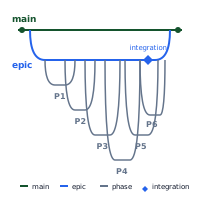
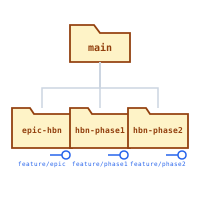
Each phase gets its own worktree, checked out from the epic branch, so you can have several phases in progress on disk at once:
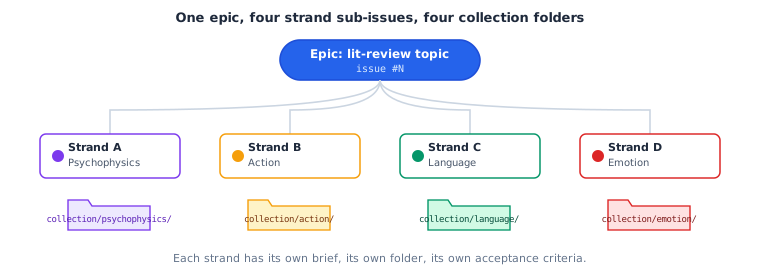
The same epic → sub-issue → worktree shape generalizes beyond code changes. epic-dev is the entry point other skills delegate to when they need git-tracked, parallelizable phase decomposition. For example, manuscript:lit-review's multi-phase mode delegates strand orchestration (one strand per literature-review theme, each with its own sub-issue, worktree, and collection folder) to project:epic-dev:
workflow-reference documents the branch, state-file, worktree, and GitHub command conventions this pattern relies on.
Before an epic or PR workflow, invoke the bundled
<project-plugin-root>/bin/project-preflight --format json executable by
absolute path; do not assume the plugin's bin/ directory is on PATH. It
reports the actual repository root, branch/worktree state, shell and terminal, GitHub CLI
command/network/auth/token status, child-shell credential inheritance, and
native-agent capability. It is read-only, never spawns agents, and keeps
optional capability failures separate from repository detection failures.
Skills
- init-project: scaffold new projects with
AGENTS.md, a Claude CodeCLAUDE.mdimport wrapper,.rules/,.context/,.memory/, and config files..memory/contains one Markdown observation per file plus an index; reruns add only missing convention files. - project-preflight: read-only startup detection of repository, shell, terminal, GitHub, and native-agent surfaces with
KEY=VALUEor JSON output - update-rules: non-destructive project sync of
AGENTS.md, theCLAUDE.mdadapter,.rules/, and.memory/convention files; user-level setup delegates toinstall-user-instructions - install-user-instructions: ask which of Claude Code, Codex, Copilot CLI, and Cursor to configure, then preview and install shared personal defaults at each documented user surface without copying them into downstream repositories
- epic-dev: the multi-phase feature workflow described above: git worktrees, GitHub issues, and phased PR delivery
- workflow-reference: branch, state-file, worktree, and GitHub command reference for epic/sprint workflows
- pr-review-toolkit: PR and recent-change review across code quality, tests, error handling, comments/docs, type design, and simplification; Codex
all/pre-merge reviews use a bounded three-reviewer Luna/max panel when preflight detects native subagents, with single/inline fallback and explicit accounting - codebase-onboarding: verified reconnaissance of an unfamiliar codebase or research field before planning or editing: a fixed bootstrap sequence, parallel read-only explorer fan-out, and a report contract separating verified facts from assumptions
- implementation-planning: strongest-tier macro design followed by worker-executable phase plans, with two registers by stakes, pre-registered decision gates, load-bearing-claim verification, and a mandatory open-judgment-calls list
- engineering-loop: the single-PR change workflow: mirror an existing pattern, pin tests first for refactors, per-commit gates against a measured baseline, review with all findings addressed or rejected with reasons
- debugging: reproduce-isolate-prove-fix-verify with anti-shortcut gates (never weaken tests or guardrails, no silent fallbacks)
- agent-fanout: orchestrating subagents and teammates within a session with explicit model tiers: Claude Fable/Opus lead and Sonnet workers; Codex Sol lead, Terra approved-plan elaboration, and Luna workers. It adds full-lifecycle briefs, mechanical gates, lead verification, mandatory cleanup of completed one-off agents, and a hard cap of 40 agents per run. This is in-session delegation, distinct from the git-tracked epic/worktree workflow above.
- ci-scaffolding: generate GitHub Actions workflows for Python (ruff + pytest) or TypeScript (biome + bun test)
- docker-packaging: multi-stage Dockerfiles with uv/bun, health checks, and security hardening
- security-audit: credential scanning, dependency audit, OWASP checklist, configuration hardening
- document-processing: PDF/image OCR, text extraction, markdown conversion
Includes autonomous agents: dependency-auditor (vulnerability scanning), release-prep (pre-release validation), and a Claude-bundled pr-review-toolkit reviewer. Codex receives opt-in Terra phase-planner and Luna implementation-worker TOML templates; Copilot exposes matching agent profiles through its native plugin manifest.
Try it
/init-project "Python EEG analysis package"
/update-rules project
"Install user instructions for Claude Code, Codex, Copilot, and Cursor"
/epic-dev "build a community dashboard"
/release-prep --minor
"Set up CI for this Python project with ruff and pytest"
"Process scanned-document.pdf and convert to markdown"
Learn more
The Agentic Research Course week 3, "Project Management with AI," covers epics, sprints, and worktrees hands-on.