Grant
The grant plugin drafts and reviews NIH and NSF grant proposals with mechanism-specific templates (R01, R21, K99, CAREER, SBIR/STTR, and more), plus a figure-QA skill scoped to grant-specific compliance checks.
The proposal pipeline
Writing a proposal is a five-stage managed pipeline, with review findings boomeranging back to an earlier stage rather than being patched in place:
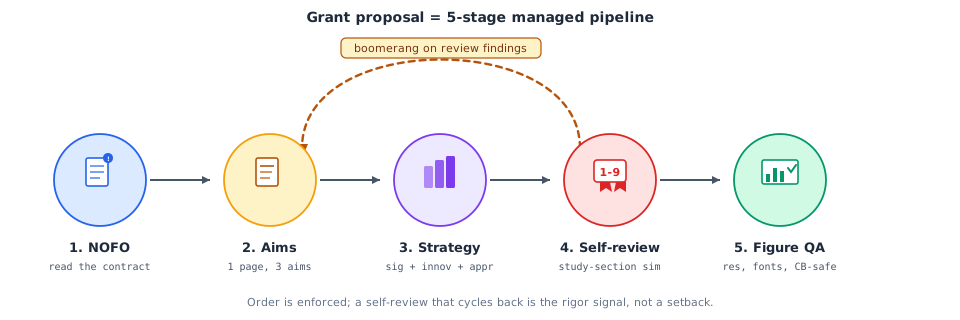
- NOFO: read the funding opportunity as a contract
- Aims: one page, three aims
- Strategy: significance, innovation, and approach, scored 1-9
- Self-review: a study-section simulation via
grant-review - Figure QA: resolution, fonts, colorblind-safe palettes via
grant-figure-qa
Order is enforced; a self-review that cycles back to an earlier stage is the rigor signal working as intended, not a setback.
Findings from the self-review stage are severity-tagged, and the severity determines where they cycle back to:
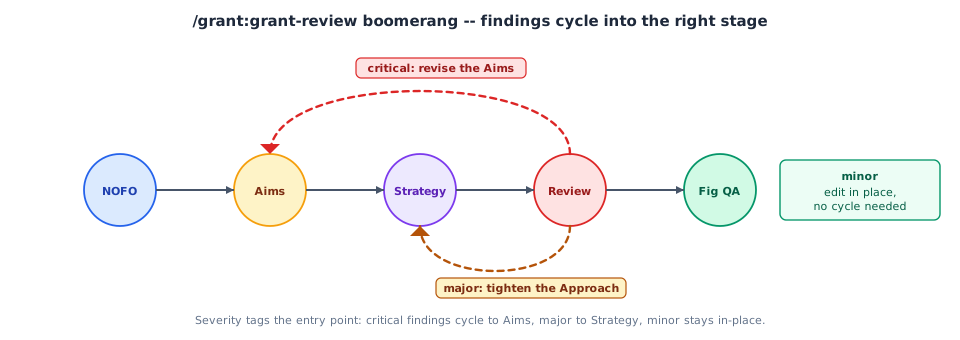
- Critical: revise the Aims
- Major: tighten the Approach
- Minor: edit in place, no cycle needed
How NIH scores a proposal
grant-review's NIH rubric mirrors how an actual study section scores a proposal: five criteria, each 1-9, rolled into one integrated impact score.
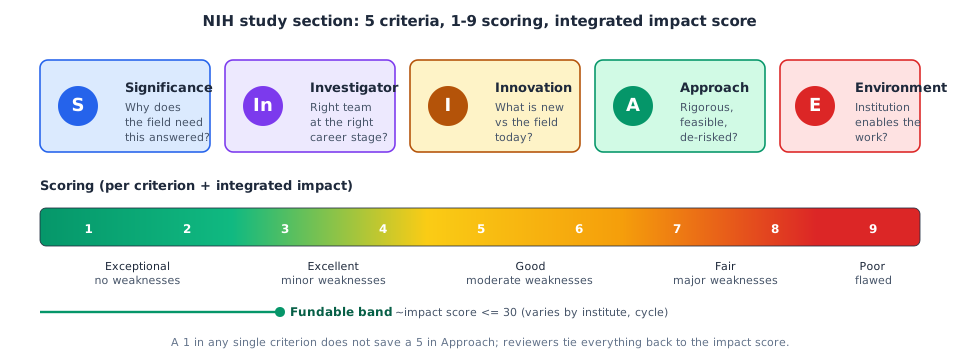
A 1 in any single criterion does not save a 5 in Approach; reviewers tie everything back to the integrated impact score, not the best individual criterion. (As of the 2025 Simplified Review Framework, RPG mechanisms score three factors, Importance, Rigor & Feasibility, and Expertise & Resources, rather than the five shown here; F fellowships and T training grants follow their own separately revised frameworks. SBIR/STTR mechanisms are outside that framework and keep the five scored criteria shown here, with commercial-potential questions inside each. See the grant-review skill for the current mechanism-specific rubric.)
Small business applications
SBIR and STTR applications are a different genre from a research grant, and the plugin treats them as one.
- Milestones, not hypotheses:
examples/sbir-specific-aims-template.mdcloses each aim with a quantitative acceptance threshold and a go/no-go condition, and contrasts itself line by line against the hypothesis-driven template. - The 12-page Commercialization Plan: required for Phase II, Direct to Phase II, Phase IIB, and Fast-Track, forbidden in a standalone Phase I, and scored.
references/commercialization-plan-guide.mdwalks its six prescribed sections. - Small business review criteria: commercial potential is scored inside all five criteria, and additional criteria cover Phase I milestones, Phase I progress, and Fast-Track acceptability.
- Funded samples:
references/niaid-sample-applications.mdindexes the NIAID sample applications and summary statements with what to study in each, andscripts/fetch-niaid-samples.shdownloads them on demand. The samples are copyrighted and licensed for nonprofit educational use, so they are referenced rather than redistributed.
Skills
- grant-writing: research strategy guidelines, writing style, budget justification, and resubmission response, with mechanism-specific templates, including a milestone-driven aims template and Commercialization Plan guide for small business applications
- grant-review: the NIH/NSF study-section simulation described above, plus a non-scoring
readabilitymode for anchored clarity rewrites before merit review; a thin-dispatch skill with a Claude-bundled fresh-context agent, a Codex agent template, and a Copilot plugin-agent template; when no agent is configured, the skill runs the selected reference procedure inline - grant-figure-qa: checks figures for resolution, accessibility, and NIH/NSF compliance, following the same dispatch pattern as
grant-review
Try it
"Write the significance section for an R01 on motor cortex"
"Review my R21 proposal at proposal.pdf as an NIH study section"
"Run a readability review on my R21 proposal before the panel"
"Draft milestone-driven specific aims for an SBIR Phase I"
"Write the commercialization plan for my Phase II application"
Learn more
The Agentic Research Course week 6, "Grant Proposal Writing," walks through NIH/NSF proposals hands-on.